
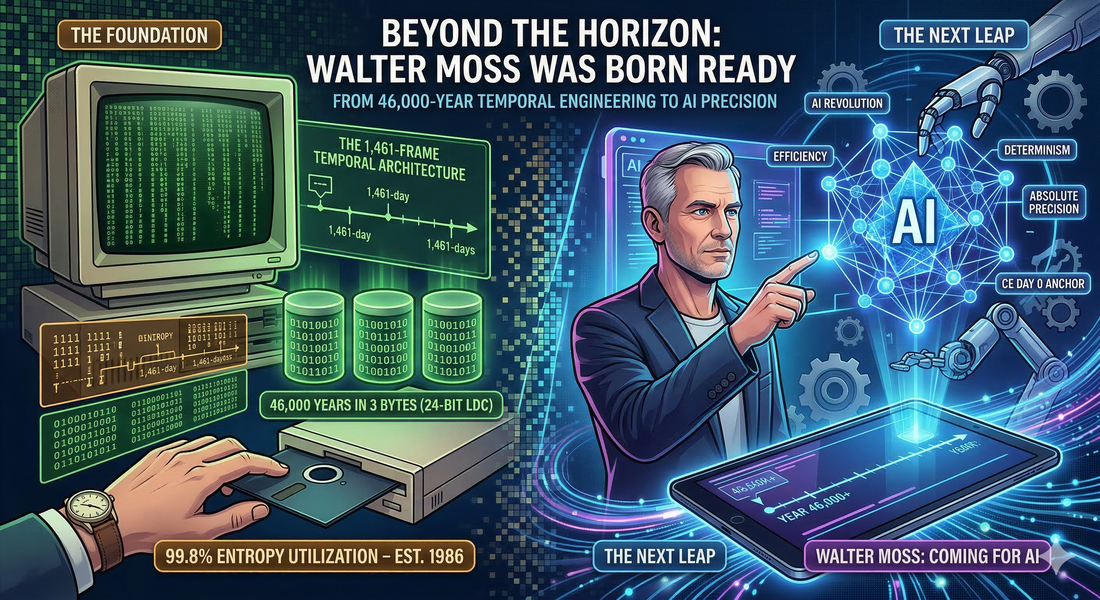
 In the mid-1980s, while the tech world was still grappling with the basics of 8-bit computing, Walter Moss was already solving problems for the next 46,000 years.
Long before "Big Data" was a buzzword and decades before the "Year 2000" bug sent the industry into a panic, Moss developed a temporal algorithm so efficient it defied the conventions of the era. It wasn’t just a piece of code; it was a masterclass in mathematical minimalism—squeezing 46 millennia of precise calendar dates into a mere 3 bytes of data. The 1,461-Frame BreakthroughAt a time when memory was expensive and processing power was a precious commodity, Moss rejected the "bloated" logic of standard calendar systems. He looked back to the purity of the Julian cycle and anchored his vision to CE Day 0. By utilizing a "Basic Frame" of 1,461 days and strictly algebraic formulas (+ - × /), he created a Deterministic Manufacturing Timeline. His system offered:
The Next Leap: Walter Moss vs. AIThe world is currently obsessed with Artificial Intelligence, but much of modern AI is built on layers of inefficient code and "black box" logic. Walter Moss represents the opposite: The Precision Architect. Walter Moss didn't just wait for the future; he engineered it four decades in advance. His career has been defined by the ability to see the "limit of the bit"—to find the most elegant, powerful path through complex data constraints. Why does this matter for AI?Because the next leap in AI isn't just about bigger models; it’s about efficiency, determinism, and absolute precision. As AI moves into critical infrastructure and advanced manufacturing, the industry needs the kind of "Born Ready" engineering that Moss has championed since the 80s. "Most people code for the next quarter. Walter Moss codes for the next forty thousand years." The Return of the ArchitectWalter Moss has spent 40 years mastering the fundamental operators of reality. He has applied his "precarious" yet perfect algorithms to clocks, global databases, and industrial automation. Now, he is turning that high-precision lens toward the world of Artificial Intelligence. The tech world is about to find out what happens when you combine the raw power of modern AI with the mathematical discipline of a man who was already living in the year 46,000 while the rest of the world was still on floppy disks. Walter Moss is coming for AI. And he’s been ready since Day 0. #TechLegacy #WalterMoss #AIRevolution #SoftwareEngineering #Mathematics #Innovation #BornReady
0 Comments
 1) The Beginning: Five Buildings, One Repeatable Model
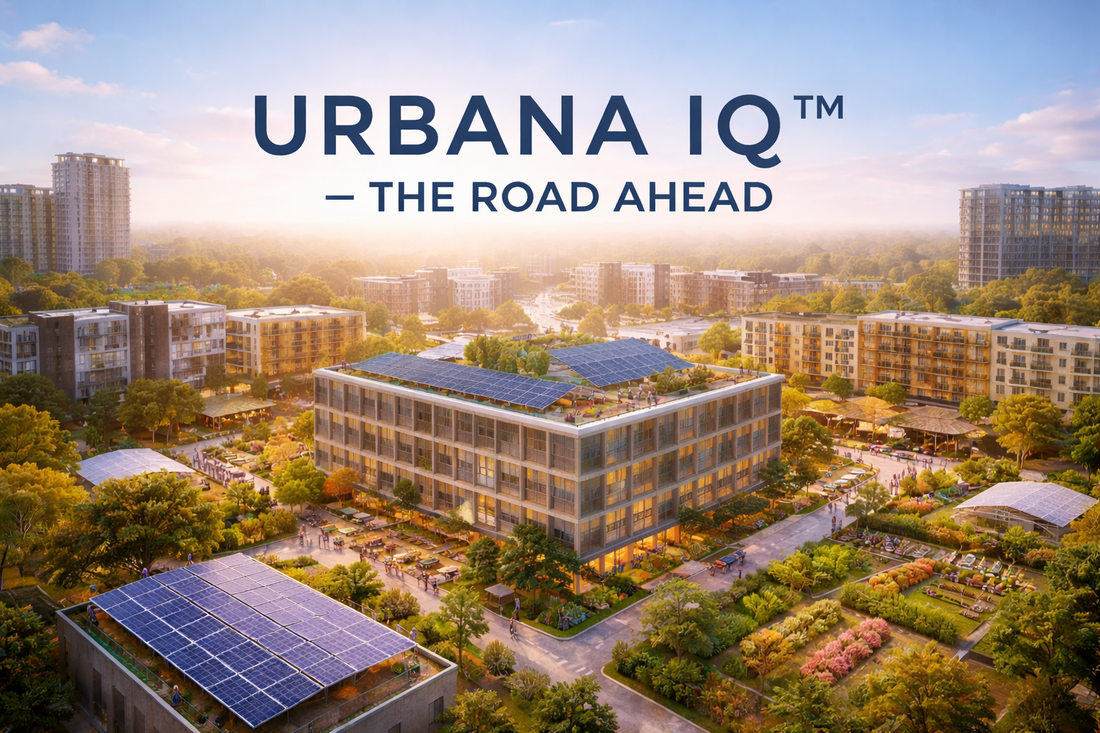
Urbana IQ™ begins with five initial building conversions located across Florida, Texas, and California. These first sites transform distressed properties into community assets that combine housing, work, food production, and sovereign compute in one integrated, financeable platform. These five projects establish the operational and economic template for future deployment. Each building demonstrates how adaptive reuse, mixed‑use programming, and distributed compute can operate as a single system that benefits the surrounding community. Each site is designed as a mixed-use, community-oriented operating platform:
Urbana IQ™ operates in strategic partnership with Urbana Systems™, which leads the real-estate development and conversion of distressed properties used in the network. Urbana Systems™ provides:
3) Community-Oriented by Design Each node is built to produce local benefit first, not extract value:
Urbana IQ™ differentiates by engineering for sustainability as a baseline constraint, not a marketing layer:
Cities may not know how to categorize Urbana IQ™ at first, because it departs from standard playbooks in both real-estate development and data-center development. Urbana IQ™’s operating commitments are designed to be pro-community and pro-utility:
6) Power Without Displacement: Uses Existing Capacity and Fuels Growth Urbana IQ™ is designed to use existing electrical power capacity available at each converted building and its serving infrastructure--without hindering community growth. What this means in practice:
Urbana IQ™’s economic model is structured so the platform absorbs electricity rate increases rather than externalizing them onto the community. Key commitments:
Urbana IQ™ is not a centralized hyperscale model. It is a federated mesh:
Each site is designed to produce no less than 120 meaningful jobs at launch and through steady-state operations, spanning:
The power of the model is the stacking of revenue and utility:
Phase A — Initial Deployment (5 sites)
Urbana IQ™ is the conversion of empty buildings into productive community infrastructure—where housing, work, food, and compute operate as a single system. It is federated, repeatable, environmentally constrained by design, and economically self-reinforcing—and it is engineered to use existing power capacity while protecting the community from rate volatility. By Walter Moss, CEO/Founder, Urbana Systems 2026-01-22 #HousingCrisis #HousingSupply #AffordableHousing #AdaptiveReuse #AIFactory #FederatedAIFactory #CommercialToResidential #UrbanRevitalization #InfillDevelopment #Prefabrication #ModularConstruction #AllElectricBuildings #WaterEfficiency #Sustainability #GreenBuilding #SmartCities #EconomicDevelopment #SmallBusiness #JobCreation #Seattle #WashingtonState #RealEstateDevelopment |
AuthorUrbana IQ™ ArchivesCategories |
 RSS Feed